On October 15, 2026, the Hanoi People's Committee signed a contract with the Vinhomes–SGC Consortium for the development of five urban railway lines: Lines 1, 2, 8, 10 and 14. With a combined planned length of approximately 253.5 km and a preliminary investment requirement exceeding VND 1 quadrillion, the programme is expected to mark a major step forward in the development of the capital's mass transit network.
Five Lines to be developed simultaneously, with completion targeted for 2030
Speaking at the signing ceremony, Hanoi People's Committee Chairman Vu Dai Thang emphasised the strategic importance of implementing the five urban railway lines simultaneously as part of the capital's long-term development strategy. Once completed, the lines will form the backbone of Hanoi's mass transit network, helping to ease traffic congestion, improve the urban environment and promote transit-oriented development (TOD).
Given the projects' scale, technical complexity and demanding implementation schedule, the city has adopted a turnkey/EPC contracting model based on the FIDIC contract framework, adapted to comply with Vietnamese law. Under this arrangement, the consortium will assume comprehensive responsibility for the entire project lifecycle, from surveying, design and equipment procurement to construction, installation, systems integration, testing, commissioning and the handover of completed facilities.
This model allows the contractor greater flexibility in organising implementation, mobilising resources and carrying out multiple work packages in parallel to shorten delivery time. At the same time, the consortium will bear significant responsibility for schedule, cost, quality and the overall integration of the railway systems.
Representing the consortium, Pham Thieu Hoa, Chairman of Vinhomes, affirmed that the consortium would mobilise the necessary resources and work closely with the city and relevant authorities to bring all five urban railway lines into operation before December 31, 2030. He also called for the city's support in accelerating land clearance, relocating existing utilities and carrying out geological surveys.
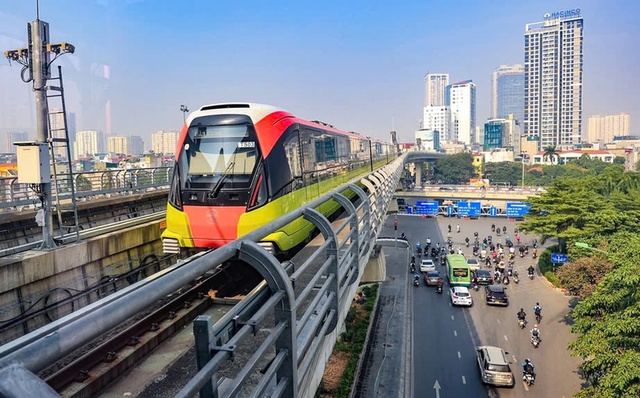
Earlier, Vinhomes signed an agreement with Alstom for the supply of 200 Metropolis trainsets for the five metro lines. Each trainset is expected to comprise five cars, designed to optimise passenger capacity and operational efficiency while meeting high safety standards.
Connecting Hanoi's Emerging Development Areas
Under the signed contract, the five urban railway lines are planned to follow these routes:
Line 1: Hung Vuong International Sports Complex – Railway Industrial Park – Ngoc Hoi – Hanoi Railway Station – Yen Vien – Thu Lam Urban Area – Noi Bai International Airport.
Line 2: Noi Bai International Airport – Nam Thang Long – Tran Hung Dao – Thuong Dinh – Thuong Phuc/Hung Vuong International Sports Complex.
Line 8: Hoa Lac – Son Dong – Mai Dich – Ring Road No. 3 – Linh Nam – Thuan An.
Line 10: Vo Chi Cong – Ring Road No. 2.5 – Times City/Vinh Tuy – Co Loa/Dong Anh.
Line 14: Thang Long Bridge – Hong Ha – Ocean Park/Gia Lam.
The network is designed to connect central Hanoi with satellite urban areas, emerging development zones, the airport and major transport hubs. It is also expected to support transit-oriented development and promote more efficient use of urban land.
In terms of technology, the lines are planned to use the standard 1,435 mm track gauge and Communications-Based Train Control (CBTC) systems, with a target of Grade of Automation 4 (GoA4), enabling fully automated, driverless train operations.
The programme also envisages the application of digital technologies throughout the infrastructure lifecycle, including Front-End Engineering Design (FEED), Building Information Modelling (BIM), Geographic Information Systems (GIS) and a Project Common Data Environment (PCDE). Hanoi also plans to study the development of a Network Operations Control Centre (NOCC) to enable centralised monitoring, coordination and management across multiple urban railway lines.
The signing ceremony on October 15, 2026, marks an important milestone in Hanoi's urban railway development programme. The five projects are expected to help establish a modern public transport system, strengthen regional connectivity and lay the foundation for sustainable urban development over the long term.
Editorial Board – TECCO1